Vogue 8904, or How I Learned to Stop Worrying and Love the Stretchy Rayon

vogue 8904 marcy tilton shingle dress sewing

A lot of important decisions I make are determined by two distinct, opinionated voices in my head. I’d like to think of them as Ambitious-Bordering-on-Irrational Dani, and Calculated-Bordering-on-Boring Dani. This past week, their conversation involved sewing.

ABOI: Should I make a dress to wear to Bianca and Jon’s wedding?

CBOB: Absolutely not.

ABOI: But I never make formalwear—it’ll be fun!

CBOB: The wedding is five days away, dummy, and you haven’t even bought a pattern yet.

ABOI: It’s fiiiine. I’ll go to JoAnn and get a nice Vogue pattern and some fabric. Kill two birds with one stone.

CBOB: But what if it doesn’t turn out? You know you have dramatic tendencies when sewing under pressure.

ABOI: I’ll pick an “easy” pattern. I’m not worried about it.

CBOB: I’m worried about it. This is a bad idea.

ABOI: [Frolics off to catch the bus to JoAnn.]

CBOB: [Yelling:] Don’t expect me to calm you down when your needle breaks and gets lost in your sewing machine at midnight on Thursday!

ABOI: Can’t hear you! Too busy flipping through pages of designer dress patterns!

CBOB: [Still yelling:] Or when you realize that the pretty dusty-rose fabric you’re about to buy is a rayon-lycra blend that will make you consider throwing your sewing machine off the roof of your building!

ABOI: Oh stop being such a grouch. It’ll be a learning experience! Plus, I have other dresses to wear if this turns out to be a total disaster.

CBOB: I guess that’s true. Fine. Do it. But I’m not buying the Spanx.

ABOI: I already did.
vogue 8904 marcy tilton shingle dress sewing

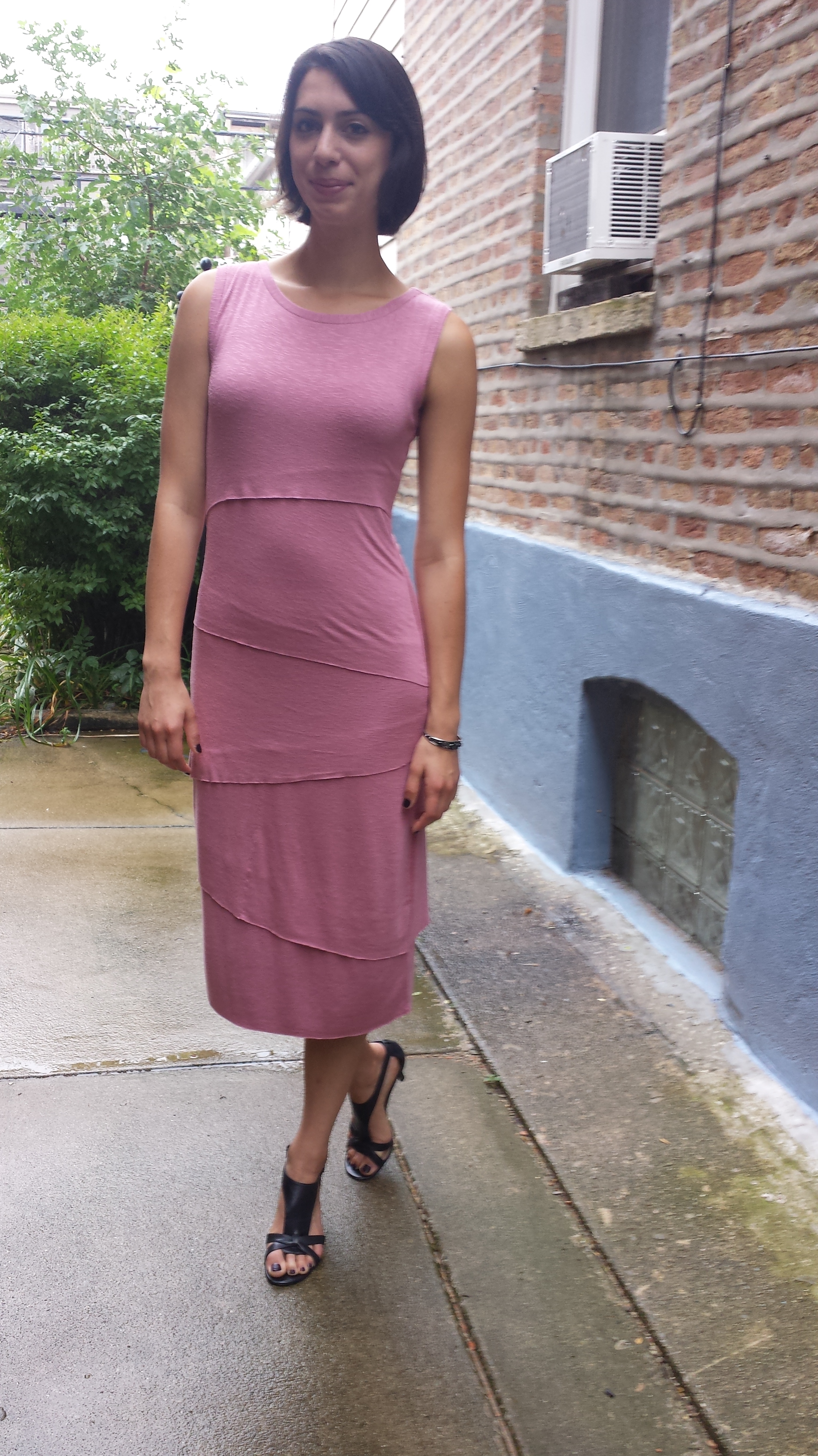
And so, Ambitious-Bordering-on-Irrational won that round. While it’s important to self-edit when it comes to project ideas, especially when precious $$$z are involved, it’s also pretty liberating to follow your gut. I’m happy to say that this particular gamble turned out well enough that I didn’t have to outfit repeat. (Not that there’s anything wrong with outfit repeating.)

Here’s what I ended up with after sifting through three giant pattern books and the limited selection of knits at JoAnn:
vogue 8904 marcy tilton shingle dress

The Pattern

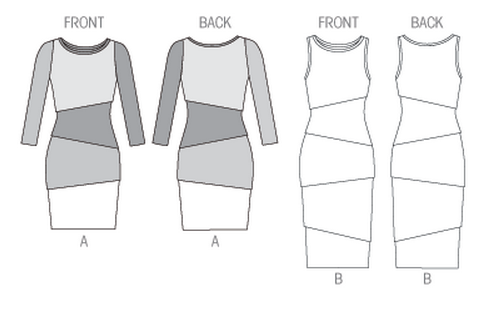
I normally avoid buying Vogue patterns when they’re not on sale for $5, but, being desperate, I made an exception for Vogue 8904. Several other bloggers who’ve made this dress have commented on its striking similarity to a layered column dress from Anthropologie. Years ago, I tried on a near-identical version of that column dress and fell madly in love. It was one of the most flattering, comfortable piece I’d ever worn, but I couldn’t justify the roughly $150 price tag. Sadly, I left it on the rack that day. Enter Vogue 8904, which not only fills the void of that layered column dress, but also offers a shorter option with sleeves for the fall/winter! I’ll definitely be trying view A (and maybe making one for a friend… eek!) at some point in the next few months.

vogue 8904 marcy tilton shingle dress

The Fabric

  • Dusty rose rayon-lycra blend with slub texturing
  • Difficulty to work with: !!@#$%^&*!!!!!
  • Cost: $17 (after using a 60% off coupon)

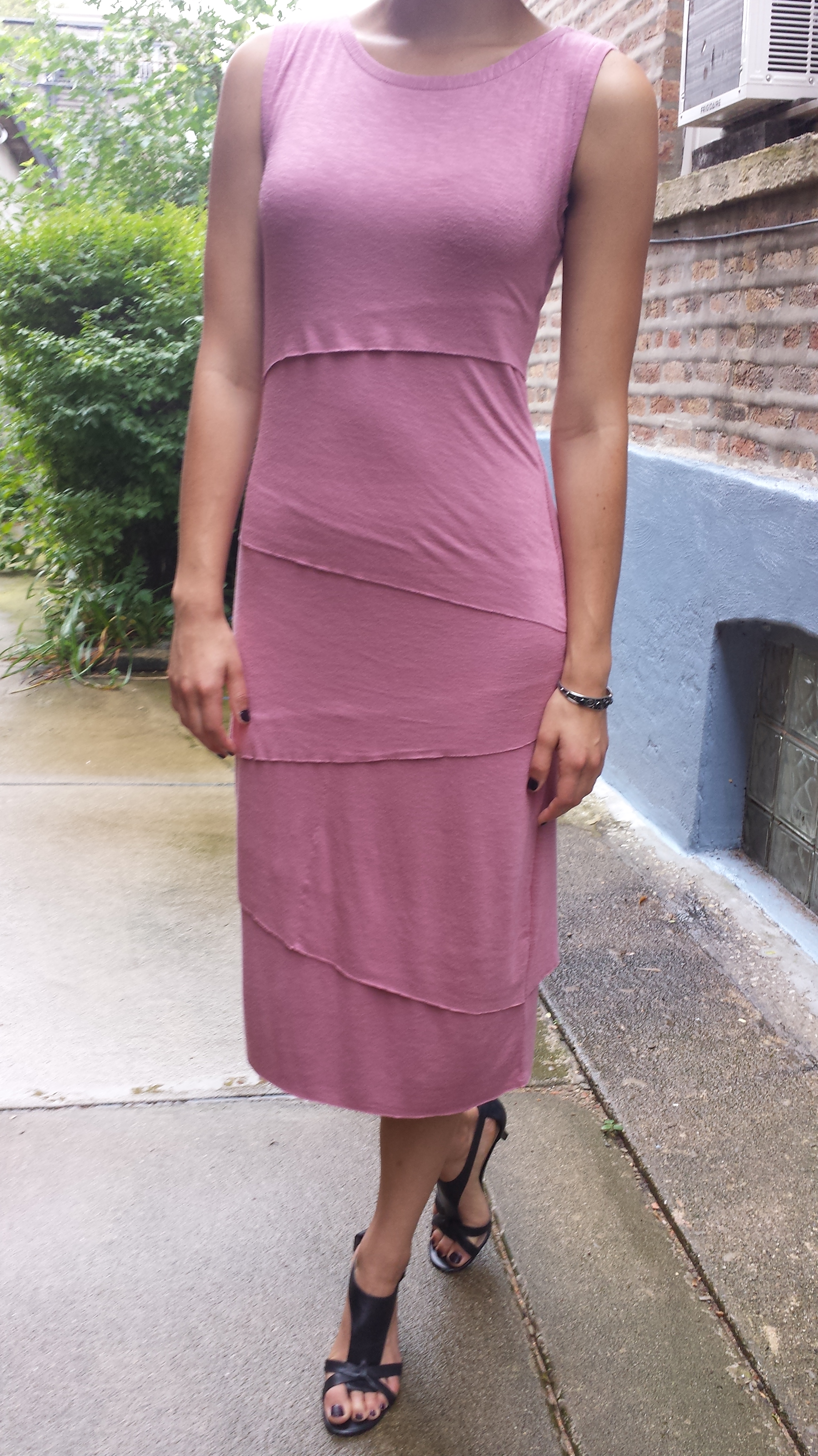
Ohhh, where to start with this one. I really should know better than to rely on the selection of knits at JoAnn, but I just didn’t have time to order anything online. I settled for a very pretty, very slippery rayon knit that turned out to be quite a doozy to lay out and cut. Using a rotary cutter helped, and that’s what I made sure to use to carefully cut the raw edge portion of the floating panels (“shingles”) that are sewn on top of the base layer. The base layer doesn’t have to be the same fabric as the shingles (mine was), but I assume it makes life easier if you use the same fabric or one with a very similar stretch/drape.

All I can say about sewing this material is thank god for my walking foot. Having the top and bottom layers feed through evenly was key to this material not ending up a puckered mess.
vogue 8904 marcy tilton shingle dress

The pattern deserves its “easy” difficulty, but it’s not a project that you can whip up in an afternoon. Marcy Tilton, the pattern’s designer, wrote an informative blog post that I highly recommend reading if you plan on trying this pattern out. It’s full of great tips and in-progress pictures.

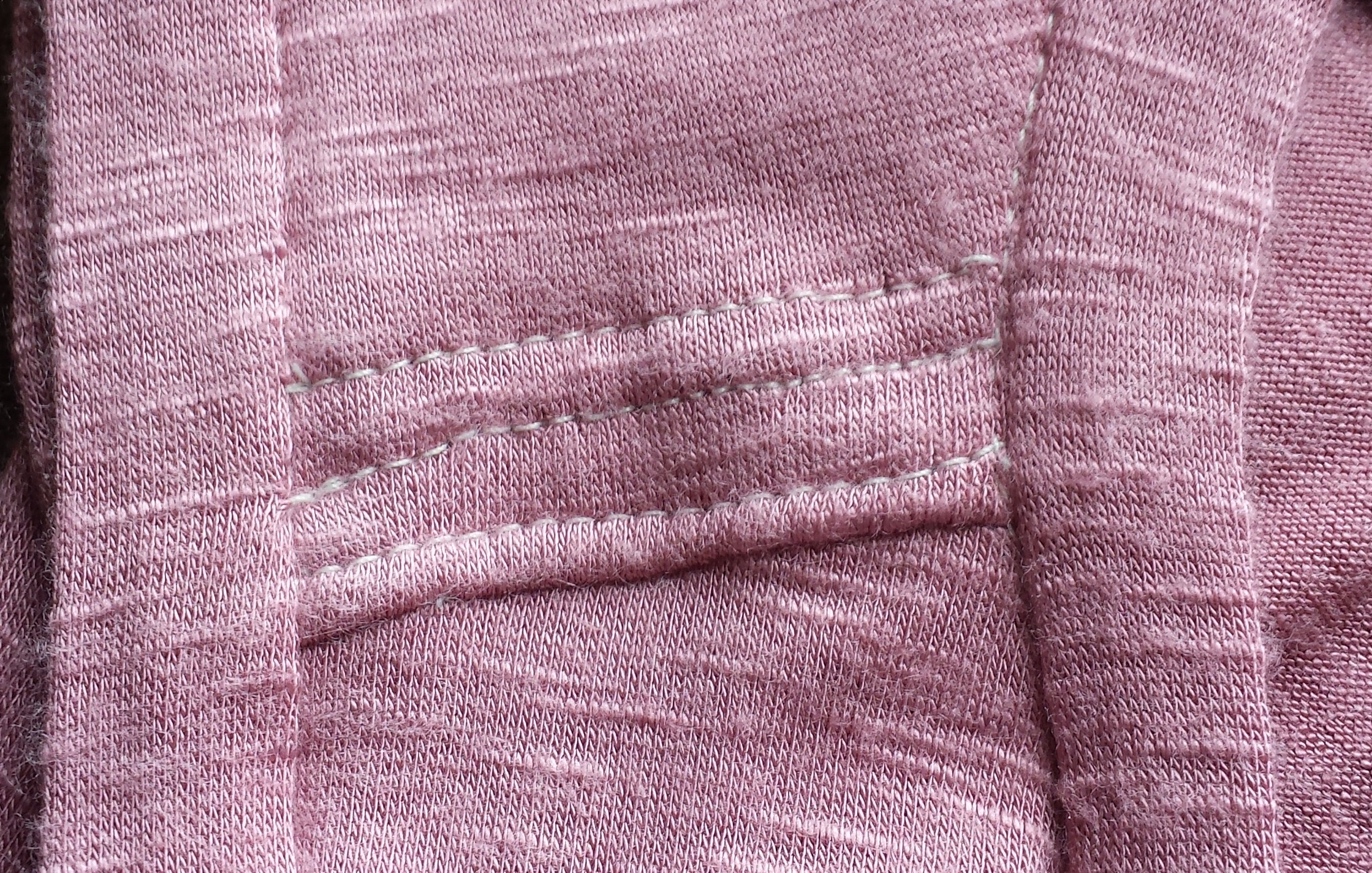
The main pain points I had during construction were with the neckline and armhole binding. I’ve never bound a knit before, let alone a super-stretchy one, and the finished neckline and armholes ended up a little droopy where I didn’t stretch enough when attaching, and a little puckered where I stretched too much. I also decided to add some self-material stabilization since the dress was getting heavy. I folded a small strip of fabric attached it with two layers of topstitching, parallel to the already existing topstitching at the shoulder. Not sure if it was necessary, but I think it made the dress feel more stable.
vogue 8904 shoulder stabilizing

Oh, and in case you noticed the strange imperfection in the second-from-the-bottom front layer, that’s from where I ran out of fabric and had to piece two scraps together. (That’s what I get for buying the last of the fabric bolt and hoping that I wouldn’t need those extra two inches.)

I was pretty worried about the clinginess of the material, but the double-layer construction (and some microfiber shorts) helped to reduce most of the cling. That said, this dress is definitely cut to hug the figure. Marcy points out that you can sew it a size bigger if you want to reduce the bootylicious factor (in so many words).

Per usual, I lengthened the pattern at the waist by about 1″ to accommodate my long torso, and I think that was the correct amount, although I’m wondering if that added length is what made the middle back panel a little droopier than the rest.

vogue 8904 marcy tilton shingle dress sewing
Wrinkles = the sign of a fun evening

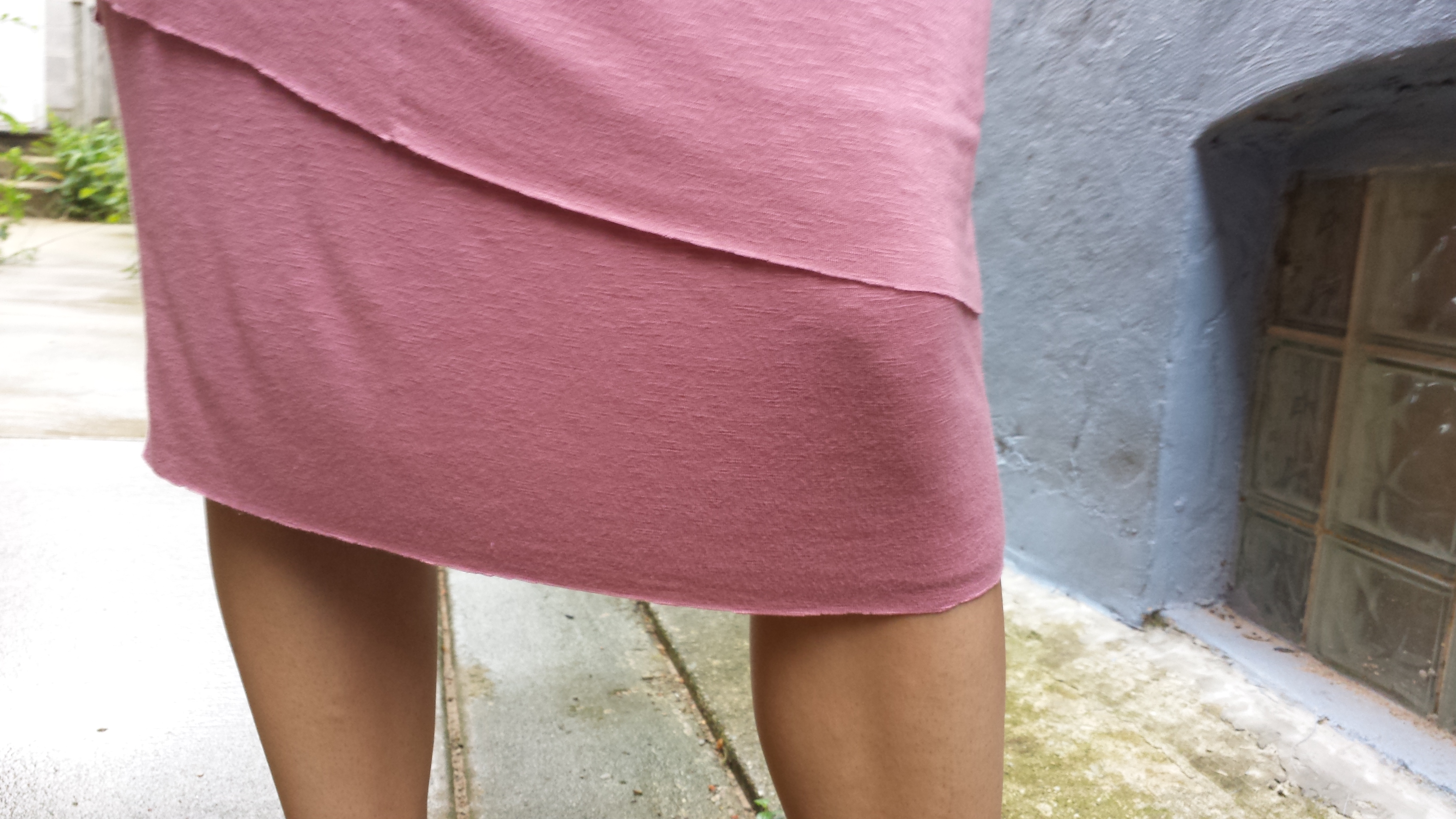
A raw-edge hem allowed for total freedom of movement.
vogue 8904 marcy tilton shingle dress

I’m happy to say that this dress held up pretty well during an amazing day that included a pre-wedding cocktail hour, ceremony, dinner, and reception full of sweaty dancing. The raw edges did start to run a little bit, and the material is already pilling under the armpits, but it pretty much felt like I was wearing fancy pajamas all evening. That’s really all a girl can ask for when it comes to formalwear. But a handsome date doesn’t hurt either.

Jon and Bianca's wedding
my date and the sexiest groomsman I know

Congratulations Mr. and Mrs. Mecoli! The outpouring of love shown at your wedding is a true testament to both of your characters. It was a beautiful day (not to mention a total blast) and made me proud to call myself your friend. Can’t wait to start sewing y’alls some baby clothes!!! 😉

Grainline Scout Tee: Knit Madewell Variation

madewell scout tee grainline studio sewing

This top was a no brainer. I had a little over a yard of black ponte knit fabric left after making this simple half-circle skirt, and I’ve been crushing on Jen’s Madewell Scout variation since she posted the pattern and sewing tutorials this spring.

madewell scout tee variation sewing

The tutorial was easy to follow and well photographed, making for a relatively quick project, albeit finished over a couple days because of weekday time constraints. Sidenote: Kudos to anyone with the patience to start and finish a project during the workweek. Try as I might, I always end up finishing on a Saturday or Sunday and then promptly celebrating with several cold beverages.

The Madewell variation calls for three changes to the original Scout pattern:

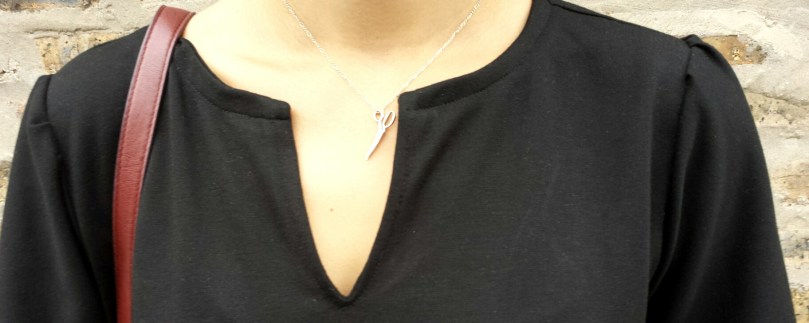
  1. Raised neckline with a split opening
  2. Slightly curved bottom hem
  3. Longer sleeves with a fold

I had every intention of incorporating each change, but I was just shy of having enough fabric for the lengthened sleeves so I sewed those up like normal. Since I used a knit, this knit Scout tutorial also came in handy when it came to cutting the fabric, hemming, and cutting neckband binding.

I’ve gotten lots of wear out of my first Scout tee, but I have noticed a tiny bit of tightness across my back from armpit to armpit. One of my goals this year is to achieve a more perfect fit with my garments, so I wanted to make sure that I addressed the tight-back issue on this Scout. A Google search turned up this gem from Threads, and it goes into lengthy detail about how to adjust a pattern piece if you have a broad back (or a narrow back, but I have no clue what that looks like since the breadth of my upper ribs rivals that of most NFL linebackers).

threads magazine adjust a pattern for a broad back

I slashed the pattern and added about a half inch between the mid-shoulder to hem, as the Threads image shows. After that adjustment, I simply altered the neckline and hemline per Jen’s instructions and got to work.

grainline studio scout knit madewell tee

Creating the split front was surprisingly easy, just make sure to leave enough binding on either side of the V (Grainline’s tutorial pic here). I left too small an amount on one side and struggled to get a clean finish on the wrong side of the garment. I also wasn’t entirely sure how to hem the curved edges where they met, so I just tapered the standard half inch hem at those spots. Other than that, this came together like a dream and is amazingly comfy. I’m glad to have some solid black staples in my wardrobe now, but my print-hungry brain is dying for an insanely bold pattern.

grainline studio madewell scout tee

The Hudson Pant is next up on my docket, so stay tuned for some possibly wacky-printed track pants. Let me know in the comments if you’ve sewn these up yet and have any tips!

Knit Half-Circle Skirt

knit half-circle skirt

I tend to gravitate toward prints. There’s something about sewing with a colorful floral, geometric print, or even an ugly-sweater knit that makes me feel happy. Plus, if I’m going to invest planning, labor, and money into an article of clothing, I want it to be more vibrant than something I can buy off the rack. The one-of-a-kind factor is part of what makes this hobby so gratifying.

Unfortunately, this obsession with bold prints means that I haven’t sewed many everyday wardrobe staples. I’m a creature of habit, and this summer the habit has been wearing the same store-bought chambray skirt roughly twice a week. It’s comfy, it goes with nearly everything in my wardrobe, and it’s weighty enough to stand up against the ridiculous Chicago wind.  But I’ve put the poor thing through the ringer, so I figured it was high time to add another versatile skirt to my wardrobe.

half-circle skirt

I’ve already gone the bold-print quarter-circle skirt route, so this time I went for a half-circle in a black ponte knit from JoAnn. I used the trusty By Hand London app again for the waist radius and length measurements, but since I was working with a knit I also heeded iCandy’s tips about subtracting 2″ from the waist measurement before plugging it into the app. Keep in mind that the app adds in 5/8″ seam allowances.

screen shot by hand london app
By Band London app screen shot

I used a homemade twine compass to trace the waist radius and length, although that part was tricky since my tracing pencil kept dragging the knit fabric along with it. I ended up marking a series of dashes that I followed with my rotary cutter. Note to self: buy marking chalk! That’d probably be more friendly on a knit, right?

For the waistband, I followed iCandy’s suggested dimensions:

Length: waist measurement minus 2″ plus 1.25″ for seam allowance

Height: double your desired waistband height plus 1.25″ for seam allowance

knit half-circle skirt sewing

The step-by-step construction of this skirt is amazingly easy. I don’t have a serger, so I attached my machine’s walking foot, inserted a ballpoint needle, and used a zigzag stitch for the seams. After stitching the back seam, I attached the waistband per the directions of the straightforward iCandy tutorial. After clipping the excess seam allowance and ironing the waistband, I hemmed the bottom of the skirt with a roughly 1″ hem. This isn’t technically required since it’s a knit and won’t fray, but I like a clean finish.

half circle skirt sewing

And that’s about it! It’s really a sewing 101 project, and an especially good one if you’re looking to break into the world of knits. I didn’t add a zipper since the material is stretchy enough to get on and off (gently) over my head, but I might try another version with a short zipper and see which is more comfortable. I’m a little afraid this material will stretch out over time, but it wouldn’t be the end of the world since that would just mean the skirt would sit a little lower.

It’s not an earth-shattering make, but it’s comfy, it fits great, and it cost under $7 total. Not too shabby for a new wardrobe staple. I’ve already paired it with my Colette Sorbetto crop top (pictured) and a tucked-in tee, and both are comfy.

What’s your most versatile piece of self-made clothing?

Portside Travel Set Dopp Kit (and the Little Pouch)


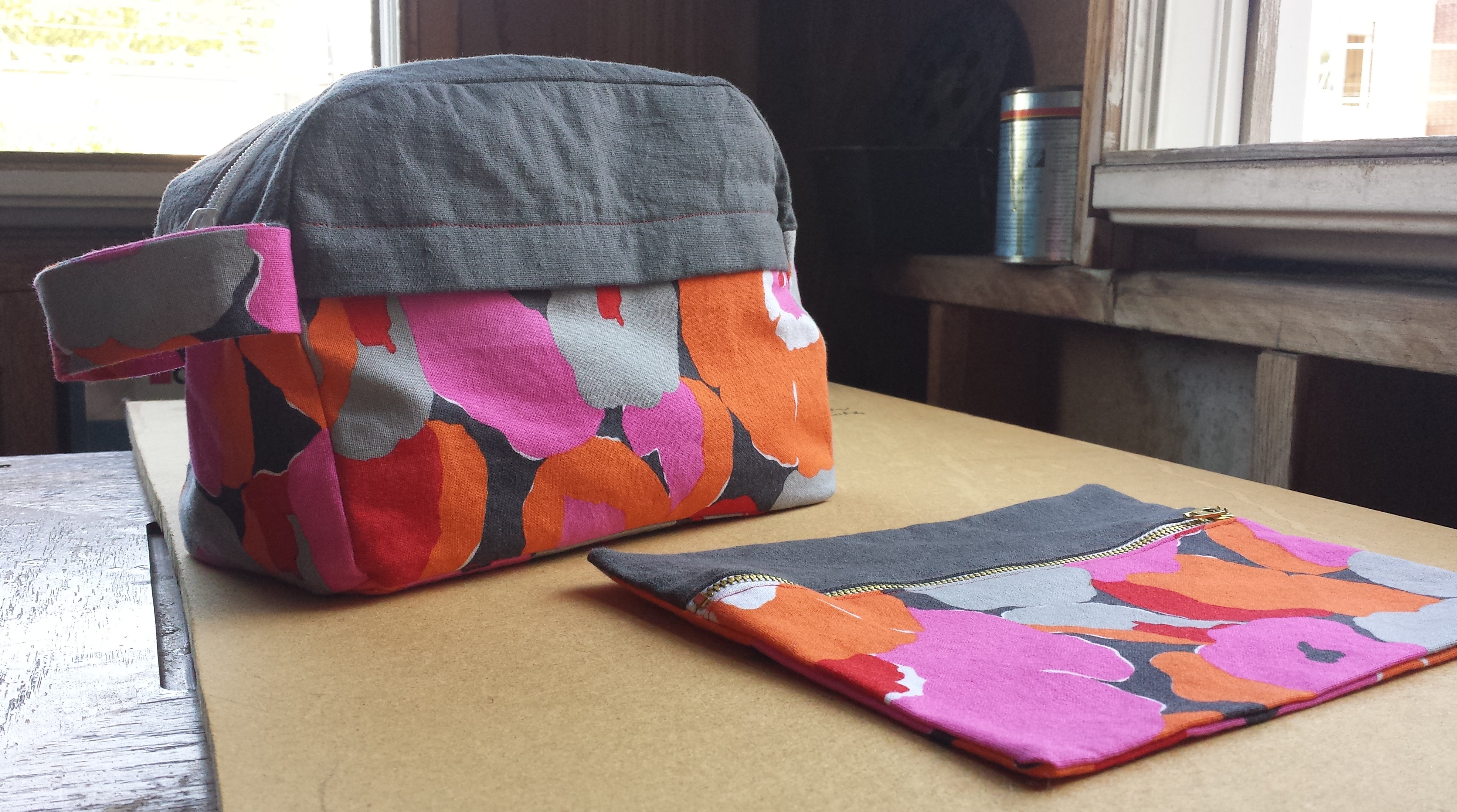
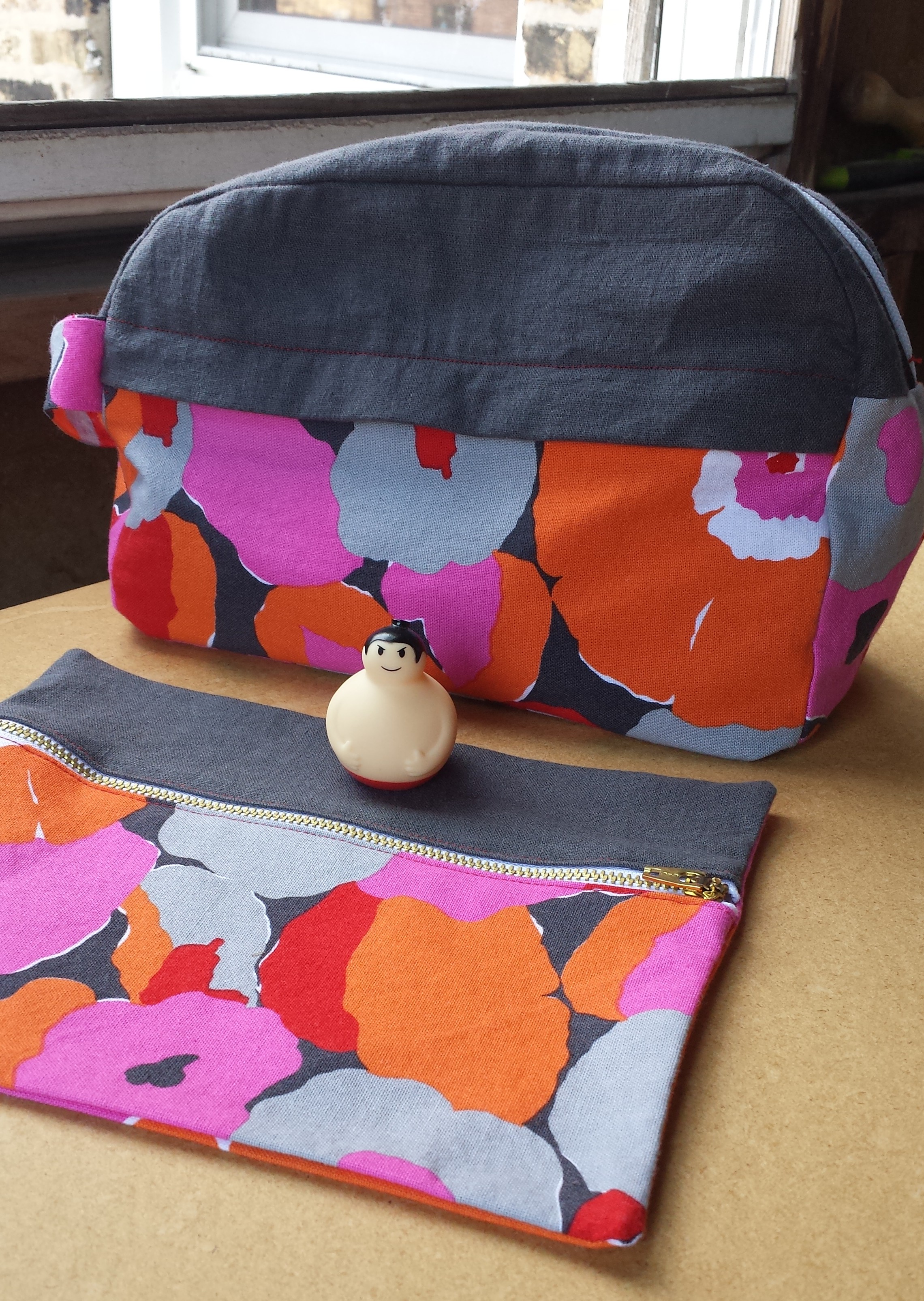
sewing portside dopp kit by grainline studio

I must subconsciously wish I was left-handed. Of the many silly mistakes I made when crafting this dopp kit, I sewed on two zippers the “wrong” way. With the dopp kit, I cared enough to get my seam ripper out, but the pouch didn’t get such special treatment. That little guy will forever open the left-handed way, or the “right” way for 10% of the population and 71% of current and former presidents for the past 40 years.

sewing portside dopp kit by grainline studio

My right-handed self found sewing this dopp kit to be a little trickier than anticipated. That might be due to my accessory-sewing rustiness; I haven’t sewn anything but apparel since I made an easy button wallet more than a year ago. Or maybe I was so excited to work on this Grainline pattern that I went at it a little too hastily. The truth is, this pattern took two days of prep before I even sat down at the sewing machine.

Because the Portside Travel Set includes three pieces (a duffel bag, dopp kit, and pouch), the PDF pattern pieces took awhile to tape together and cut. I reserved the next evening for cutting everything out and applying the fusible interfacing. And on the third night, she collapsed in a pile of the sewing-room (aka office/closet) floor, her hand hanging limp in an empty Mexican take-out container. That’s partially true. But really, on the third day I got to work whipping up the dopp kit.

sewing portside dopp kit by grainline studio

Fabrics: Robert Kaufman red floral cotton for the self fabric, J. Crew gray linen-cotton blend for the contrast, and HeatnBond medium fusible interfacing

I love the Marimekko-like floral print, and it’s a decent enough weight for a bag. The gray contrasting fabric, however, is a little too lightweight for my liking, plus it wrinkles super easily. Next time I’ll use heavier duty fabric, or try interlining the bag with sew-in interfacing (like the pattern recommends if you’re looking for a heftier feel).

sewing portside dopp kit by grainline studio

I won’t go into supreme detail on every step of the sewing, but here is a list of things I’ll keep in mind for next time:

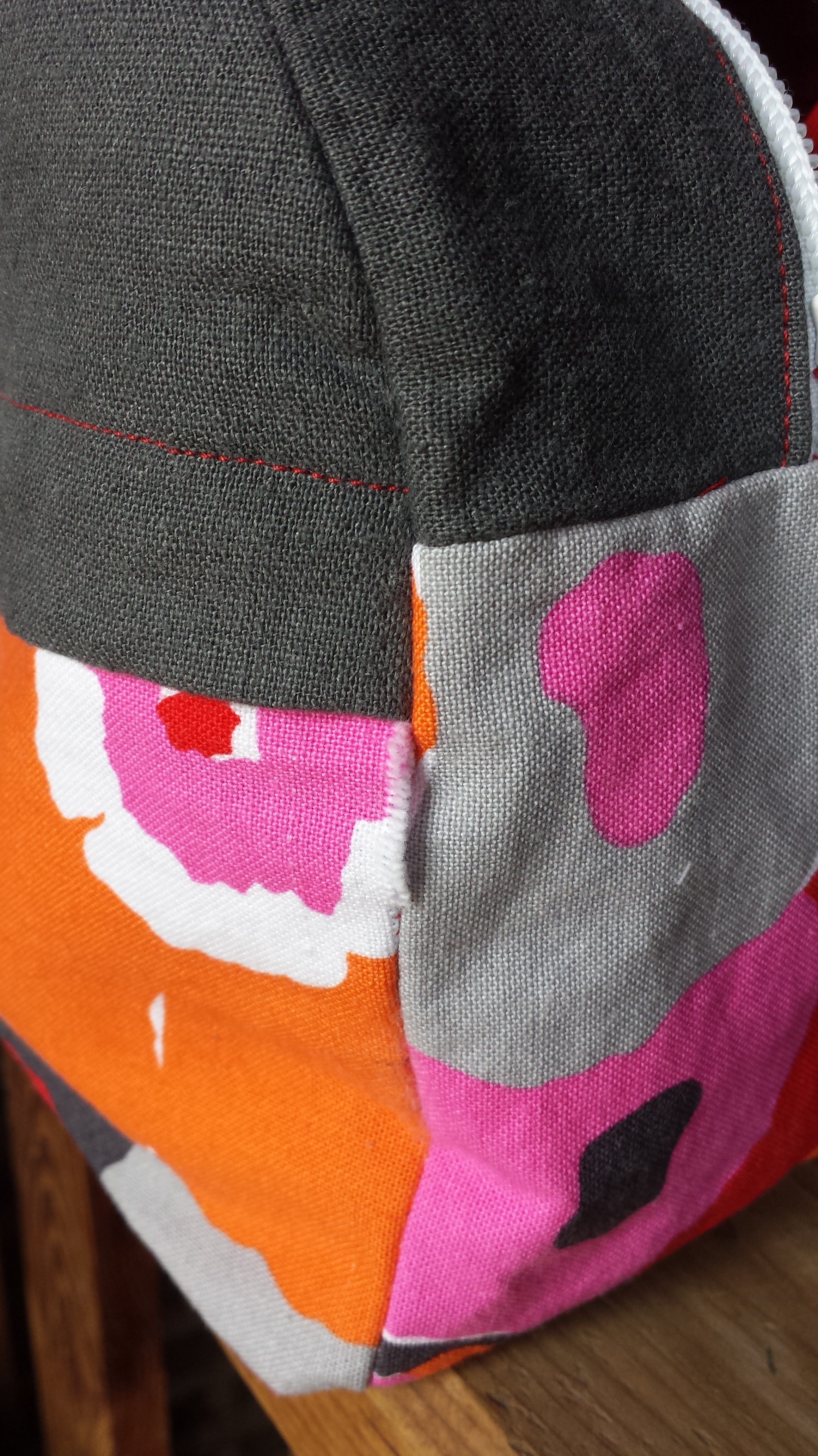
Transfer all of the pattern notches on the actual fabric. I somehow failed to do this for every piece, and when it came to sewing the rounded edges of the top and sides, it was a little hairy. I think that’s why my bag is slightly misshapen.

When sewing multiple layers, pin properly! I thought I was done when I noticed a raw edge peeking out on the front of the kit:

sewing portside dopp kit by grainline studio

Not a good feeling, especially when you’ve just finished hand-sewing the lining into place and have to rip out yet another set of stitches.

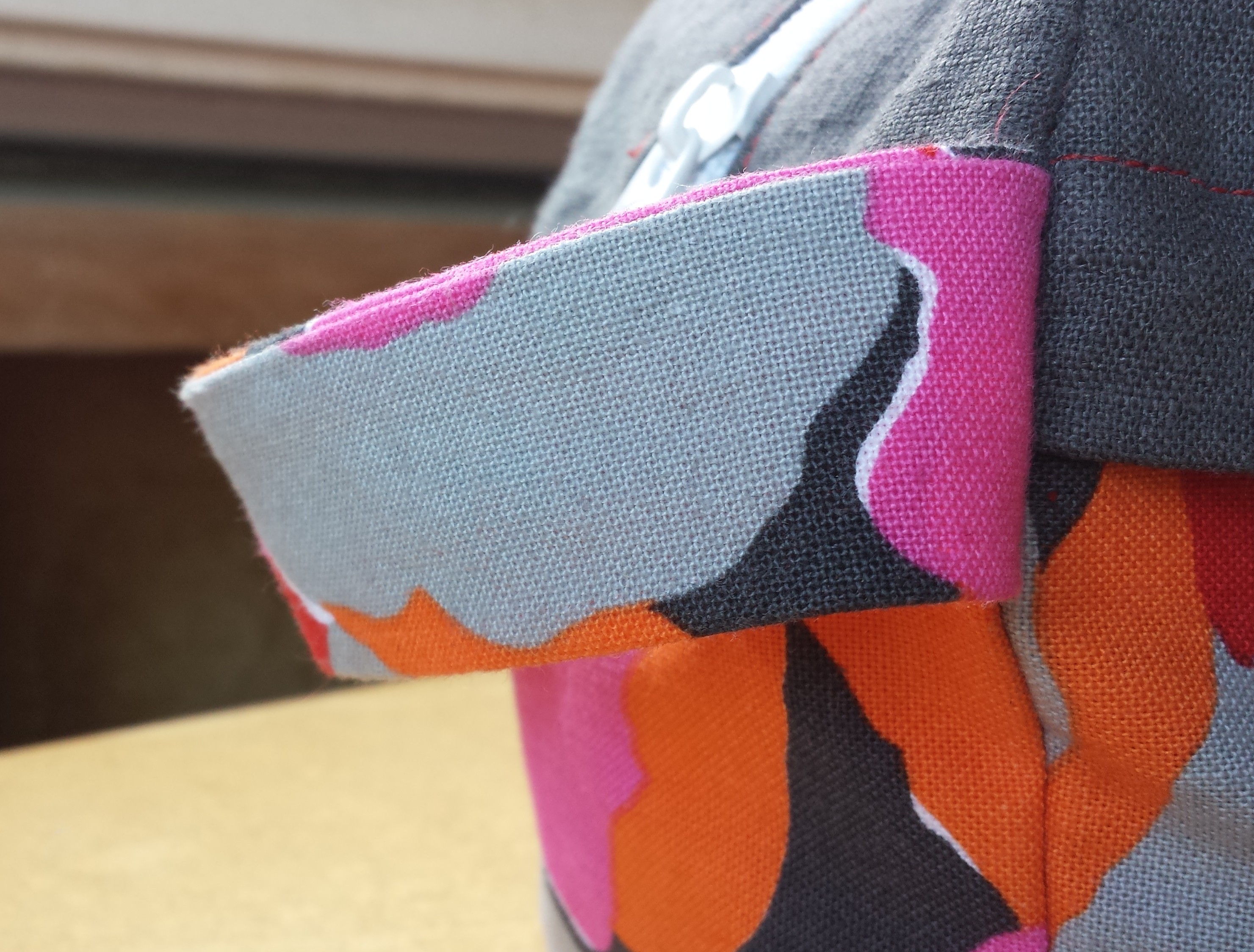
Don’t forget to topstitch the strap. In my late-night sewing delirium, I misplaced the strap I’d already sewn together and topstitched. After a fruitless 5-minute search, I sewed another strap. No big deal, except that when I attached it to the dopp kit, I forgot to topstitch the damned thing! This is what happened when I tried to machine topstitch when it was already sewn on the bag:

sewing portside dopp kit by grainline studio

Yeah… I immediately ripped those stitches out and now the strap is less structured than I’d like, but at least it’s not looking superjanky.

portside dopp kit

Double-check the cutting layout. I ended up short one piece when it came to Step 25, which calls for a “self front piece” when creating the pocket. I’m still not sure where the problem stems from. (Scratches head.)

And that’s the gist of it. My dopp kitt, though a little floppy, is already growing on me. Oh, and the pouch! Pretty straightforward zipper pouch, although it’s even floppier than my dopp kitt because it didn’t call for any interfacing or lining.

sewing portside pouch by grainline studio

It doesn’t really need it though, especially if you buy a heavier fabric and are planning on using it like me: to hold only crisp, new $2 bills. Just don’t forget to sew the zipper on the right way, y’alls!

And now for some gratuitous shots:

sewing portside dopp kit by grainline studio
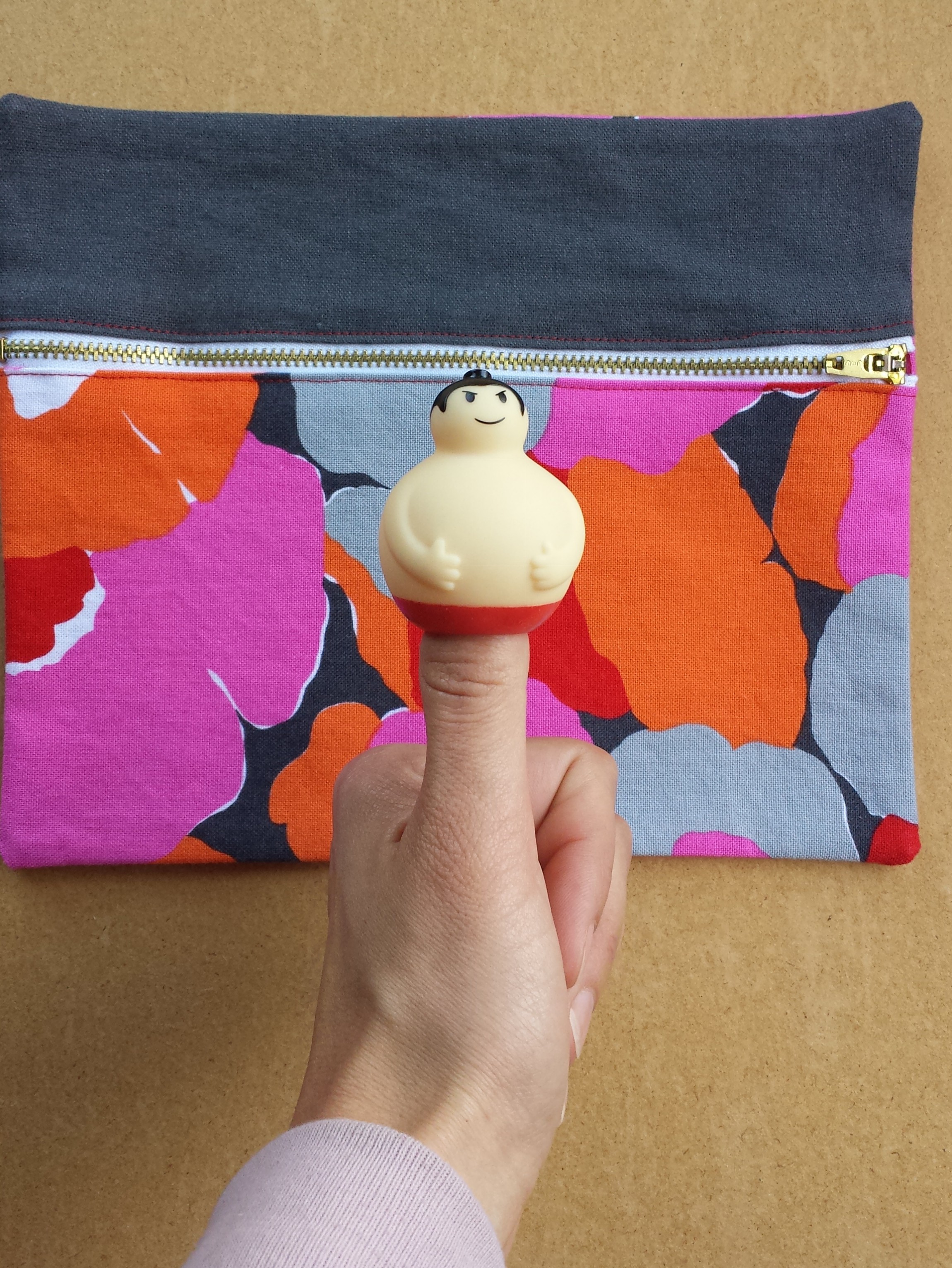
Toiletries… and a mysterious sumo wrestler.
sewing portside dopp kit by grainline studio
Whip stitchin’
sewing portside dopp kit by grainline studio
looks friendly enough…
sewing portside dopp kit by grainline studio
… but there’s something devious about those eyes!

sewing portside dopp kit by grainline studio

sewing portside dopp kit by grainline studio
Thanks for modeling, thumb-wrestling sumo man. Now I know why you have a constant look of angered surprise on your face.

Next up: the Portside duffel bag?

Sew Quilted Coasters with Leftover Fabric

Sorry for the dinky length of this post—I’m headed to Minneapolis this evening to be reunited with a dear college friend and his cat Barbie (whom I am not plotting to steal), but I didn’t want to neglect the blog for a full week. So, coasters!

sew quilted coasters

I made these quilted coasters months ago following a simple Martha Stewart tutorial, and I use them nearly every day. Whether you make 1 or 20, they’re a great way to use up leftovers from your Island of Misfit Fabric Remnants.

sew quilted coasters

The best part about these coasters is that you can throw them in the wash when you inevitably spill coffee or red wine on them.

Obviously I had to make some gratuitous comically undersized coasters:

comically undersized quilted coasters

comically undersized coasters
coasters for all of your drinking needs!

If you have any clever ways to utilize leftover fabric, post in the comments below. Happy sewing!

Sorbetto Part II: The Crop Top

colette sorbetto crop top

Weekend sewing > weekday sewing. I don’t remember the last time I’ve churned out two items of clothing within a four-day span, and it feels gooood. On an average weekday, I might break into a cold sweat at the thought of making and applying bias tape sometime in between an after-work run and dinner. This glorious morning, I sat with a cup of coffee while listening to Marc Maron’s charming neurotic rants, happily pinning bias tape to the edges of my nearly finished Sorbetto #2. Having nowhere to be and nothing to do on Sunday mornings has become my favorite (non)pastime. That and screaming at the TV during World Cup games. I had no clue soccer was so full of drama and biting! Anywho, on to the garment:

colette sorbetto crop top

I’m a big fan of the structured, polished crop tops that have been dominating runways and fashion blogs this summer, but I couldn’t seem to find what I envisioned (or one that was worth the $70 at Topshop). After whipping up my first Sorbetto a few days ago, I thought it might be the perfect candidate for a pattern-hack crop top.

All I did to alter the pattern (which I’d already tweaked for the last Sorbetto) was take off 3″ of length and decrease most of the flare that occurs toward the hem.

colette sorbetto crop top
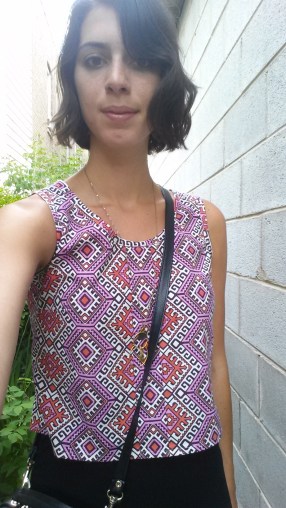
a “headed to the pharmacy” selfie

I love this Amy Butler fabric—it’s billed as a quilting cotton, and I think the added heft really helps achieve a more structured look. At 3″ shorter than the original, the length is perfect. Here, I’m wearing the top over a lightweight jersey slip dress (I’m all for the no-skin-showing crop top), but I can see pairing this with a midi skirt or even some pants or shorts if they hit high enough on the waist.

colette sorbetto crop top
blurry pic + derpy face

The one thing I dislike about this top is the armholes. Somehow, these armholes are higher than my first Sorbetto, even though I cut them from the same pattern. I wore this top around for a few hours today, and it was comfortable, but my armpits could definitely stand for some more breathing room. I’m wondering if it just feels tighter since this top is a thicker cotton, rather than a lightweight chambray? Either way, I’m going to give it another wear and then decide whether or not I want to hack those armholes down.

Now that I’ve made a couple Sorbettos, I feel like I owe it to the ladies at Colette to cough up for a non-free pattern of theirs. Any favorites?

Hope you had a relaxing holiday weekend filled with lots of fireworks and patriotic Jell-O molds!


Chambray Colette Sorbetto Top

Colette Sorbetto top

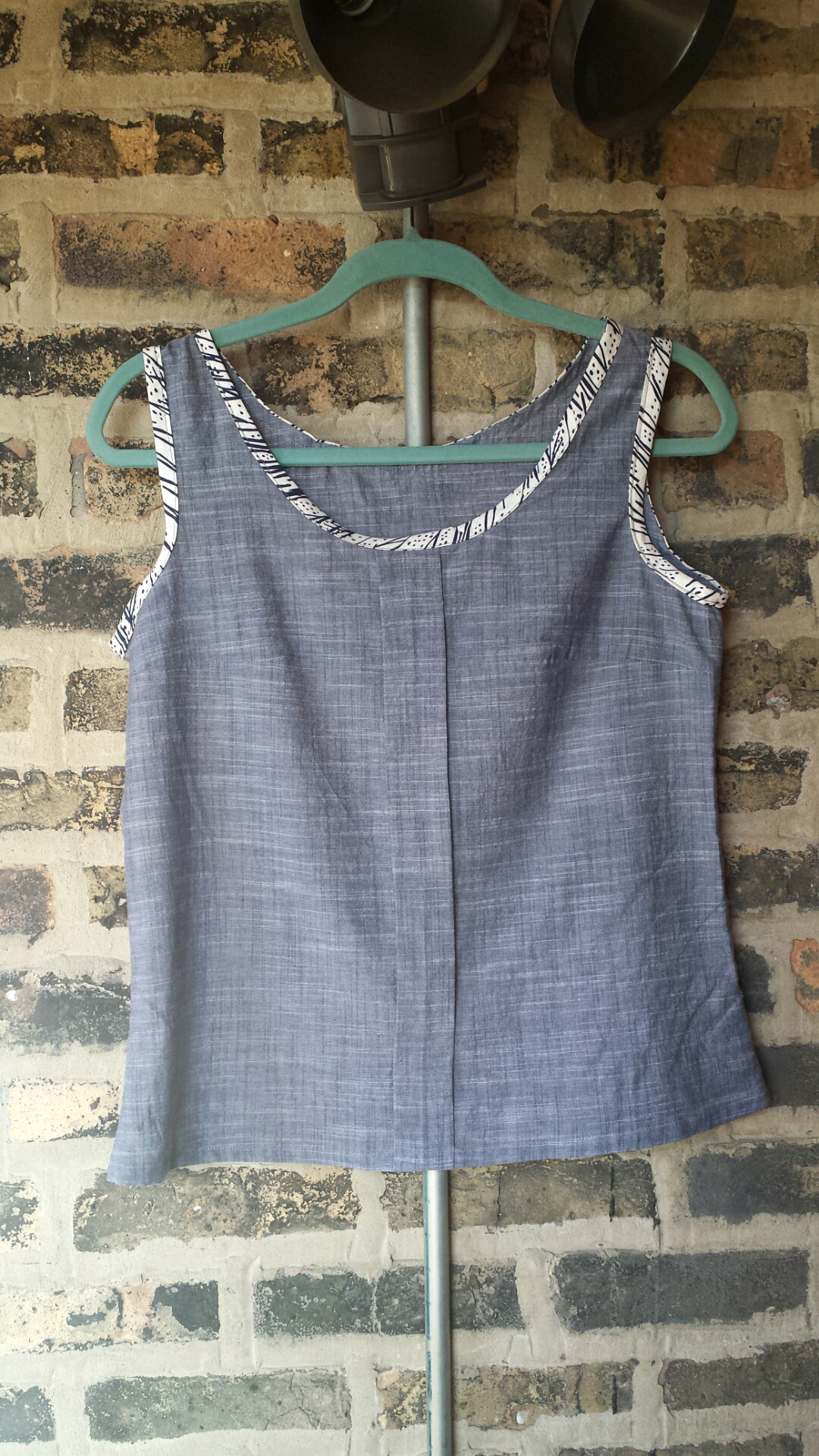
For the July installment in the Summer of PDF Sewing Patterns, I went with a pattern that cost $0. That’s right—the Colette Sorbetto top is a FREE download! If you sew, this is probably super old news. I admit that I’ve seen images of this shirt (and hacks of this shirt) floating around the blogosphere for awhile now, but I’d never actually taken the plunge myself. Am I glad I finally did? I…. think so.

After reading what felt like 10,000 reviews of Sorbetto, I decided to make a few adjustments to the pattern before cutting out my fabric. For the record, I’m 6’0, wear a size 6/8 in dresses, and have a broad back and a long torso. Using Colette’s sizing chart as a guide, I cut a 6.

Colette Sorbetto pattern

Some reviewers mentioned that the top cut into their armpit, so I cut the armhole down to where it is for the size 12. I also cut the neckline down about 1″, because I get a little sweaty/panicky with high-cut necklines. My clavicle needs to breathe, y’alls. For length, I added 2″ to the waist area and about 1/2″ to the hem.

One of the most common complaints I’d seen was that the bust darts were waaaay too high. Since my whole upper half—from shoulder to hipbone—is long, I figured I’d need to lower the bust dart. Full disclosure: For some reason, I hate tracing bust darts onto fabric. That said, I tried to trace equal darts onto both side of the bodice, at roughly where the size 12 darts lie north/south and where the size 6 darts lie east/west.

On to the actual sewing!

Colette Sorbetto top

Pros

  • The pattern was super easy to follow. The directions are spot on, and thanks to their in-house continuous bias binding tutorial, I now know how to make tons of bias tape from a measly 10″x10″ fabric leftover.
continuous bias binding
Scrap of fabric destined for the trash becomes…
bias binding
…nearly 100″ of binding. Magic!
  • The pleat! I’ve never made anything with a pleat before, and I love it. It was super easy with the help of a nice steamy iron. (Sidenote: my old starter Rowenta has a broken handle and leaks water everywhere—any tips on good irons?)
  • It requires very little fabric. I bought 1.5 yards of this Robert Kaufman lightweight chambray, and I probably have enough leftover to make another shirt.
  • Comfort. It feels like I’m wearing pajamas. (Hell, maybe it looks like I’m wearing pajamas, too.)

Colette Sorbetto top

Cons

  • It’s short. Even after adding length in the torso and the hem, it felt a little cropped. Maybe that’s just the style of the shirt. Either way, I prefer my tops a little longer, especially if they’re woven.
  • The darts are too high. Surprise! My half-assed attempt to place these darts didn’t work. In fact, one was almost a full inch higher than the other (it was barely grazing boob at this point), so I had to seam rip that sucker and re-sew it. This was after I’d already sewn the side seams. Needless to say, I’m very happy my lightweight fabric stood up the the challenge of exasperated me + a seam ripper.
  • The bottom is slightly flared. It doesn’t necessarily look bad, it’s just not my style.
  • It’s a little tight in the upper back. It’s not uncomfortable, but since the rest of the shirt is so breezy, I’d like a little more breathing room for my oversize ribcage.

Fourth of July outfit

Overall, I’d say the pattern itself is well-drafted and includes amazing directions. (Colette really lives up to it’s motto, “Patterns that teach.”) Because a lot of Colette’s patterns are vintage-inspired, I think they might run a little short for me. I like the Sorbetto I made, but it’s a little swingy at the bottom for me. With it tucked into my red-white-and-blue shorts, I might just have a Fourth of July outfit on my hands. Now all I need is a Budweiser and a ketchup stain running down my chest.

Colette Sorbetto top

Anywho, I’m excited to take another stab at Sorbetto with a different fabric, maybe trying one of the fun modifications I’ve seen (like this scalloped edge) or trying a crop top version. Has anyone tried a crop? I’m curious to know before I go wasting fabric and end up crying in a heap of leftover thread and crumpled pattern pieces. (This has never happened.)

Happy Fourth!

Grainline Studio Scout Woven Tee

sewing project grainline studio scout tee

I think it’s safe to say that Grainline Studio’s Scout Woven Tee is the darling of the indie pattern world. I’ve read rave reviews from probably 15+ bloggers at this point, most commending the pattern for its sizing, breezy fit, and ease of construction. Not to mention that it makes it really easy to highlight a fantastic print.

But, being slightly cynical, I wasn’t quite sold by the blogosphere’s near-unanimous praise. A slouchy, loose-fitting T-shirt with no bust darts (no darts at all, actually), to be made with a nonstretch woven fabric. Uhhh, I’m all for embracing this summer’s boxy shirt trend, but I was a little afraid this would veer into the “looks like you’re wearing a tent” arena. Still, at only $6.50 ($7.50 total because of dumb Illinois tax), I had to give it a shot.

Scout calls for a lightweight woven fabric. Per usual, I hit up the Needle Shop in Chicago’s North Center, where I found a beautiful Leah Duncan hyacinth fabric (not in stock anymore).

It’s 100% cotton and super soft—really an awesome print for summer with its crisp off-white color and pops of navy. I washed and dried it, then got to work laying out my PDF pattern pieces and cutting out the fabric.

There are only four pattern pieces total—the front, back, sleeves, and bias neckline binding—making the cutting process a total breeze. The pattern includes seam allowances (my last PDF pattern did not), which is another huge plus in my book. So far, so good, Scout.

scout tee bias neckline sewing

After sewing the back and front pieces together, I used Grainline Studio’s tutorial, Getting Flat Bias Necklines, to finish the scoop neck. If you haven’t visited the Grainline Studio website, check it out. Jen Beeman, the brain behind Grainline, sells her PDF patterns there and also shares super helpful tutorials and tips that complement her designs. Plus, I read an interview that revealed she lives in Chicago and likes Black Dog Gelato, the best dessert in the city/state/world. OK, done fan-girling and pining for goat cheese cashew gelato. Back to the pattern!

I finished the bottom with a simple double-fold hem. Next were the sleeves, and the directions call for a double row of basting stitches in order to gather the sleeves when attaching them to the bodice. The sleeves went in without a hitch, and I finished each edge with another double-fold hem and gave the whole thing a quick press.

At this point, I was… done?! How could it be!? Surely this was too good to be true. I’d never sewn a (wearable) shirt in less than 90 minutes, so naturally I assumed it would look wonky when I tried it on.

To be honest, I wasn’t 100% sure about it when I first tried on the finished product. I usually wear more fitted tops or ones that are cinched at the waist. This tee is kind of the opposite of all that. The garment details aren’t lyin’ when they say that “this top falls into a loose shape below the bust.” But within 15 minutes of wearing Scout, I was converted. It’s loose, yet somehow manages to skim the body in a flattering way. It’s also insanely comfortable. I can see pairing this shirt with everything from linen shorts to skinny jeans or even tucked into a pencil skirt with a belt thrown on top. This is really a great, simple pattern and I can’t wait to sew up a few more. Maybe I’ll try Jen’s Madewell Scout variation next.

Grainline Studio Scout woven tee sewing

And that’s about it! PDF pattern #2 complete for my summer challenge. If they’re all as easy and awesome as Scout, I might need to up the ante and start sewing two or three per month! Any personal favorites?